Reviewing an Elf Graphics Asset for Client Holiday Projects
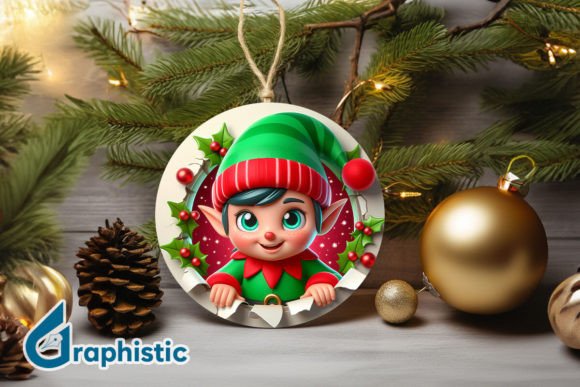
When a client needs holiday visuals, the first impression of an asset sets the tone. Opening the file for 3D Cute ELF Christmas Ornament F 126, the immediate mood is playful, whimsical, and undeniably festive. This isn't a generic snowflake or a stern Santa; it's a character-driven illustration with a 3D depth that feels warm and handmade. The style leans towards a modern, cute aesthetic, popular in boutique branding and craft-centric businesses. It naturally fits clients aiming for a cheerful, approachable, and slightly nostalgic holiday feel—perfect for a small handmade brand, a local bakery's seasonal campaign, or an Etsy shop launching a Christmas product line.
The Elf's Role in Real-World Design Scenarios
In a practical client project, such as visual concepts for a family-owned gift shop's holiday launch, this asset must perform across multiple mediums. For brand identity and logo design, the elf could serve as a charming secondary mark or a seasonal logo variation, but its detail means it needs careful scaling. In product labels and packaging design for limited-edition holiday items, it becomes a strong decorative accent. Placed on a mockup of a hot cocoa box or a cookie bag, it instantly elevates the packaging from plain to themed.
For marketing visuals, like posters, flyers, and invitations for a community holiday market, the elf works excellently as a hero graphic or a focal point. Its 3D style creates a center of interest. In social media graphics for a campaign, it can anchor Instagram posts or Pinterest pins, driving a cohesive visual story. As a digital asset for Canva templates or printable designs, it gives content creators a polished starting point for cards or blog visuals.
Where This Illustration Shines Brightest
This graphic design asset excels in applications where its character and detail can be appreciated. Use it boldly in large layout areas: as a central element on a holiday poster, a website banner, or the cover of a digital catalog. It's ideal for product mockups where the ornament itself could be featured on a mock mug, tote bag, or t-shirt design for print-on-demand or sublimation design. It serves beautifully as a decorative accent in themed collections—think a series of holiday stickers or a set of printable wall art. For campaign visuals and packaging details, it adds a layer of personalized charm that generic clipart cannot.
Potential Pitfalls and Considerations for Professional Use
However, in a crowded layout with complex text and other elements, the elf's intricate details might compete. Use it carefully at small sizes, such as in a footer icon or a tiny web button, where the 3D effect and features could become indistinct. On a complex background with low contrast, it may lose visual impact. For projects requiring a very clean visual hierarchy or a minimalist, professional corporate aesthetic, this asset would likely feel too decorative. Its emotional appeal is high, but its suitability for a formal financial institution's holiday newsletter, for example, is low.
Impact on Brand Perception and Design Execution
Integrating 3D Cute ELF Christmas Ornament F 126 into a client's project directly affects brand consistency, visual trust, and audience engagement. For a handmade business or a small business branding project, it reinforces a friendly, creative persona. It boosts emotional appeal, making the design feel more personal and engaging. The overall impression gains professionalism when the asset is used appropriately—it shows deliberate, mood-aligned visual selection rather than a random holiday graphic.
But this hinges on proper execution. The asset must support readability; text placed near it should be clear, not overwhelmed. It should enhance, not disrupt, the visual hierarchy. For a client's commercial design project, ensuring it aligns with the existing brand color palette and style is crucial.
A Designer's Practical Checklist Before Client Use
Before committing this asset to a real client project, I run through a standard set of tests. First, test it in black and white to see if the form holds without color. Check contrast on both light and dark backgrounds to ensure it remains visible. Preview it at small and large sizes in the actual layout software. Place it on real mockups—a t-shirt, a mug, a social media post template—to judge context. For printable designs, a test print is essential to check color fidelity and detail retention.
I review the provided file formats. An SVG design offers vector editability for scaling and color adjustment, which is invaluable. A clean PNG design with reliable transparency allows for easy compositing. I compare the illustration alongside different font styles—a serif, a sans serif, a script—to see which pairing feels most cohesive for the project's tone. Most critically, I confirm the commercial license explicitly. Using a digital product for a client's Etsy product, marketing visuals, or print-on-demand merchandise requires a license that permits such commercial use. This due diligence is non-negotiable for professional work.
The Final Verdict for Creative Marketplaces and Projects
For designers, brand owners, and content creators operating in creative marketplaces, 3D Cute ELF Christmas Ornament F 126 represents a versatile, mood-specific design asset. It's not a foundational logo element, but a powerful decorative component. It can transform a basic holiday social media graphics set, add uniqueness to a Cricut project for stickers, or provide the central art for a printable design like frame-worthy art. Its strength lies in its character and 3D styling, which, when matched with the right client project—a boutique, a craft brand, a seasonal local event—can significantly improve the visual mood and polish of the final design. It’s a reminder that in modern design, even a single, well-chosen illustration can carry the emotional weight of a whole campaign.